
Shauna Ironside is an osteopathic manual practitioner, certified athletic therapist, athlete, and mother of three. She has a busy clinical practice located in Ottawa, Canada, where she has been helping bodies of all ages and stages lead pain-free, healthy, strong, active lives. Learn more about Shauna here.
I originally wrote this Perifit review in 2020 after buying a Perifit with my own money to help with my pelvic organ prolapse and, honestly, to make myself more consistent with my pelvic floor exercises.
Six years later, I still use Perifit.
I also recommend it regularly to patients who are looking for a way to better connect with their pelvic floor muscles at home.
A lot has changed since I wrote my original review. Perifit has added new games and features to the app, and more importantly, they released the Perifit Care+, which is now the model I recommend for most people.
So before you dive into my very detailed original review, here is the short version.
MY PERIFIT REVIEW: THE SHORT VERSION
Yes, I recommend Perifit.
I think the greatest value of Perifit is the real-time biofeedback. So many people have trouble knowing whether they are actually contracting their pelvic floor muscles properly, or relaxing them properly. Perifit gives you something you normally don't get when doing pelvic floor exercises at home: feedback.
And then there are the games.
Pelvic floor exercises can be really, really dull. It’s probably why you don’t do them. Perifit somehow manages to make them fun. Or at the very least, much less boring.
That matters because the best pelvic floor exercise program in the world isn't going to help very much if you don't actually do it.
Which Perifit would I buy?
If I were buying one today, I would choose the Perifit Care+.
The original Perifit Care is still a great little pelvic floor trainer, especially if you plan to train primarily while lying down. But the Care+ is smaller, slightly curved and flexible, and can be used much more comfortably in sitting, standing and during movement.
That was the big thing missing from the original Perifit for me.
Our pelvic floor doesn't just need to work while we're lying on the bed. It needs to respond while we're walking, lifting, running, jumping, coughing, carrying kids and doing all the other things we ask our bodies to do.
The Care+ gives you more opportunity to train and get feedback in those positions.
Perifit CARE VS. Perifit CARE+
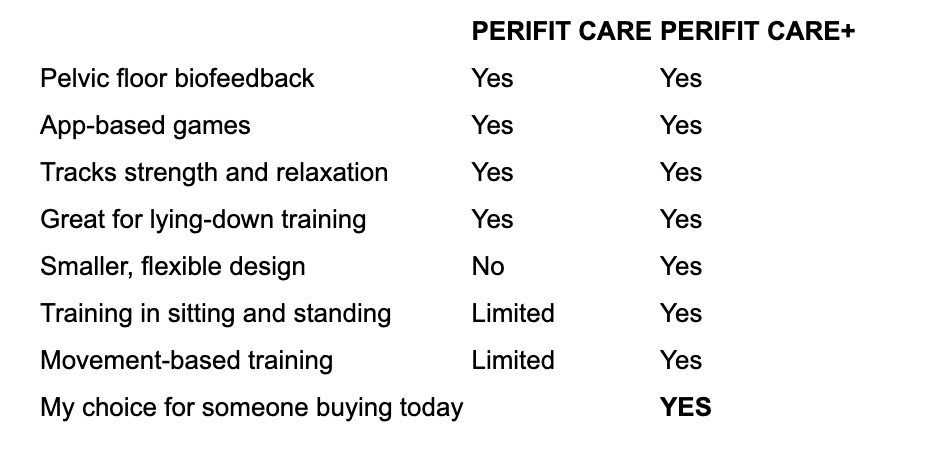
If you already own the original Perifit and you're happily using it, I don't think you necessarily need to rush out and replace it.
But if you're deciding between the two for the first time, I would choose the Care+.
You can read my much more detailed Perifit Care+ review here if you want to see how I tested it while sitting, standing, squatting, doing kettlebell swings and even doing a few plyometrics.
SAVE 25% ON PERIFIT
The lovely people at Perifit currently offer Healthy Mumma readers and clients 25% OFF Perifit Care+ or the original Perifit Care.
Use my code HM25 to save 25%.
I originally purchased my Perifit with my own money. After I published this review, Perifit invited me to become an affiliate. If you purchase through my link or use my code, I receive a small commission from Perifit at no additional cost to you.
My opinions here are my own, and I only recommend products that I genuinely think may be helpful to my patients and readers.
Perifit currently also offers a 100-day trial on the Care and Care+, which gives you some time to actually use it and decide whether it's right for you.
MY PERIFIT REVIEW 2026 UPDATE
MY PERIFIT REVIEW: THE LONG VERSION
I first purchased my Perifit in 2019.
At the time, I had mostly healed a mild pelvic organ prolapse that developed during my third pregnancy, but I was doing a terrible job of remembering to do my pelvic floor exercises.
I wanted something that would keep me accountable.
I was also curious.
Patients were regularly asking me about pelvic floor training devices and I had never actually used one. As an athletic therapist and osteopathic manual practitioner, I wanted to be able to give people an informed opinion rather than simply repeating what I had read online.
So part of purchasing my Perifit was for my own health, but part of it was professional curiosity.
Then COVID hit.
I had been meaning to write a review for months, but apparently it took isolation-life for me to finally sit down and do it. At the time, many people suddenly had very limited access to pelvic floor physiotherapy and other hands-on care, which made tools that could be used at home particularly interesting.
Thankfully, that part of the world has changed.
What hasn't changed is my opinion that nothing replaces good one-on-one care when you need it, but having a tool at home that helps you understand what your pelvic floor muscles are actually doing can be incredibly useful.
A FEW THINGS BEFORE YOU READ MY PERIFIT REVIEW
1. I bought my original Perifit with my own money.
When I originally wrote this review, there was no sponsorship or affiliate relationship with Perifit. I bought one because I wanted to use it myself and decide whether I would recommend it to patients.
2. I had a pelvic organ prolapse.
I developed POP during my third pregnancy. I worked really hard to heal it and eventually fully resolved my symptoms. Perifit came into the picture toward the end of that process when I needed some motivation to continue working on my pelvic floor muscles.
You can read more about how I healed my pelvic organ prolapse here.
3. I know my body.
I am an athletic therapist and osteopathic manual practitioner. I went into my first experience with Perifit already understanding how to contract, relax and coordinate my pelvic floor muscles.
Not everyone is starting from that same place.
This is one reason I strongly recommend working with a pelvic floor physiotherapist, especially if you have pain, leaking, pelvic pressure, prolapse or you're simply unsure what your pelvic floor is doing.
4. Perifit was the first pelvic floor training device I used.
My original review wasn't a comparison of every pelvic floor device on the market. It was my experience using Perifit.
5. These are my opinions.
Perifit is a training and biofeedback tool. It isn't a substitute for diagnosis or treatment from a pelvic health professional.
Here are a few updates since my original review:

1. PERIFIT HAS ADDED NEW PELVIC FLOOR TRAINING GAMES
Perifit has added a bunch of new games to the app! This is great news! And trust me, they are all so different and fun, they will keep you committed as you try to level up and unlock the new games.
Also, know that once you have unlocked a game, you can add it to your preferred list. How great is that? If there is a game that you didn’t love simply keep it “unchecked” from your list. Your favourite games will be cycled for your training enjoyment.
2. USING PERIFIT PELVIC FLOOR TRAINER IN UPRIGHT POSITIONS AND WITH EXERCISE…WELCOME THE CARE+
I tried using the original Perifit in various positions, but it just didn’t have the flex and design needed. It is fabulous for lying positions, and this is the position I suggest my clients start in, but it is not designed for any other position.
And since we spend most of our day in an upright position, you better believe that your pelvic floor is responsive, strong and flexible beyond the bed!
The Perifit Care+ has come along and with it the ability to sit, stand and even do exercise or basic movements with it in and staying put. You can read my full review of the Perifit Care+ here.
WHAT IS THE PERIFIT PELVIC FLOOR TRAINER?
The short:
You play video games with your pelvic floor muscles.
Yes, you read that correctly.
Perifit is a biofeedback device that connects to an app on your phone or tablet. As you contract and relax the muscles of your pelvic floor, sensors inside the device detect what you're doing and that information controls what happens on the screen.
It's a little weird at first.
It's also pretty brilliant.
The important part isn't really the video game. It's the feedback.
You can actually see when you're contracting, how strongly you're contracting and whether you're relaxing again afterward.
The ability to relax your pelvic floor is important. Pelvic floor training isn't simply about squeezing harder and harder.
This is one reason I don't love using the word “Kegel” to describe pelvic floor training. Kegels are usually associated with contraction, when a healthy pelvic floor needs to be strong, coordinated AND able to relax.


YOUR PELVIC FLOOR IS MORE THAN JUST YOUR PELVIC FLOOR
This part is really important.
Pelvic floor support issues such as leaking and prolapse are multifactorial.
Your pelvic floor muscles are only one part of the system.
Your breathing, alignment, core strength, hip strength, digestive health, bowel and bladder habits, activities, daily postures, pressure management and even stress can all affect how your pelvic floor functions.
Perifit can help you work on the muscles of your pelvic floor.
It cannot fix all of those other things.
So please don't buy a Perifit thinking this little device is going to solve every pelvic floor problem you have.
It is a tool.
A very good tool in my opinion, but still one piece of a much bigger picture.
HOW DOES PERIFIT WORK?
Once you've downloaded the Perifit app and connected your device, the app guides you through an assessment and training program.
And then it's playtime.
The games respond to your pelvic floor contractions and relaxation.
When I first got mine, I played for more than thirty minutes because I kept wanting to level up.
When was the last time you willingly did pelvic floor exercises for half an hour?!
That is what I immediately loved about Perifit.
It took something boring and made me want to keep doing it.
Over the years Perifit has continued to add games to the app, which I really like. You can also select the games you enjoy and leave out the ones you don't.
Trust me, you will have favourites.

There is also a Practice Lab/manual-style mode that lets you watch what your pelvic floor is doing in real time without having to play a game. I use this quite a bit because it gives you an interesting look at strength, relaxation, pressure and how your pelvic floor responds to things like breathing.


WHAT I LOVE ABOUT PERIFIT
1. COMPLIANCE + MOTIVATION
This is still number one for me.
Perifit makes pelvic floor training fun.
It takes a bit of getting used to controlling a video game with your nether parts, but once you get going you want to improve your score, unlock games and see your numbers change.
That motivation matters.
Trust me, this is way more interesting than sitting there with a weird look on your face trying to remember the elevator exercise your therapist gave you.
2. REAL-TIME FEEDBACK
This is probably Perifit's biggest clinical value.
One of the most common problems I see is simply that people can't properly connect with their pelvic floor.
They don't know if they're contracting it.
They don't know if they're relaxing it.
They don't know whether they're using other muscles to compensate.
Your physiotherapist can give you wonderful feedback during an appointment, but she isn't following you home to watch every exercise you do.
Perifit gives you feedback when you're on your own.
3. RELAXATION
There is a surprising amount of “down” time in the Perifit games.
I love this.
The ability to completely relax your pelvic floor is really important, and in some people learning to relax is just as important, or more important, than learning how to contract strongly.
Perifit has always done a good job of incorporating this.
4. TRACKING
Strength.
Endurance.
Accuracy.
Relaxation.
Progress.
If numbers motivate you, there is plenty to look at.
I like being able to see how things change over time rather than simply guessing whether my pelvic floor training is working.
5. ACCESSIBILITY
Pelvic floor physiotherapy is incredibly valuable.
It also isn't accessible to everyone.
Cost, geography, childcare, work schedules and simply getting yourself out the door can all become barriers.
Perifit doesn't replace physiotherapy, but it does give you a way to train at home and get feedback while you're doing it.
I think there is a lot of value in that.

WHY I NOW PREFER THE PERIFIT CARE+
The Care+ fixed the biggest limitation I had with the original.
It is smaller, curved and has some flexibility between the sensors.
I found it much more comfortable and much more secure during movement.
I tested mine lying down, kneeling, sitting and standing.
I used it with dead-bugs, resistance-band pulldowns, squats and kettlebell swings.
I even tried some hops, high knees and jumping jacks.
This was HUGE for me.
Being able to see what the pelvic floor and internal pressure are doing while moving opens up an entirely different way of using the device.
If your symptoms happen while you're standing or moving, eventually it makes sense to work toward training in those positions, not only lying down.
That doesn't mean everyone should immediately start jumping around with a Perifit in.
Start simple.
Build control.
And ideally work with someone who understands pelvic floor rehabilitation if you're dealing with symptoms.
But having the option is a major improvement.
This is the main reason I recommend Care+ over the original Perifit if you're buying one today.
WOULD I RECOMMEND PERIFIT?
I think you know the answer to this.
Yes.
I bought my first Perifit because I was curious and needed some motivation to keep doing my pelvic floor work.
Years later, I still use it.
The number one issue I see many women having with their pelvic floor is simply connecting to it.
Biofeedback can be enormously helpful for this.
And then there is the FUN aspect.
Doing pelvic floor exercises consistently is not particularly exciting. Perifit takes something that most people are not very motivated to do and turns it into a little game.
If a silly video game means you actually train your pelvic floor consistently, I call that a win.
WHO DO I THINK PERIFIT IS BEST FOR?
I think Perifit makes the most sense for someone who:
knows they should be doing pelvic floor exercises but struggles to stay consistent;
has trouble feeling whether their pelvic floor is contracting or relaxing;
likes visual feedback and tracking progress;
wants something they can use at home between pelvic floor physiotherapy appointments;
wants to work on general pelvic floor strength and control;
or simply wants to be proactive about pelvic floor health.
If you're having significant pelvic pain, unexplained symptoms, worsening prolapse symptoms or you're unsure whether strengthening is even appropriate for you, I would start with a pelvic floor physiotherapist rather than simply buying a device and going at it alone.
More contraction is not always the answer.
A FEW TIPS FOR USING PERIFIT
1. THINK ABOUT THE FRONT PART OF YOUR PELVIC FLOOR
If you're having trouble contracting your pelvic floor muscles, especially during a strong or sustained contraction, think about the FRONT of your pelvic floor rather than only squeezing around the back.
We often find it easier to squeeze around the anus.
Try bringing your attention forward and see how the contraction changes.
2. WARM UP IN THE PRACTICE LAB

Before jumping into a game, spend two or three minutes playing around with your pelvic floor.
Try:
slow, wave-like contractions;
quick contractions;
completely relaxing between contractions;
watching what happens when you inhale;
watching what happens when you exhale;
gently engaging your core;
and noticing whether your glutes want to join the party.
You're learning about your body here. Play around with it.
3. DON'T SQUEEZE YOUR GLUTES
Try to keep your glutes and other surrounding muscles relaxed.
When you're trying to create a maximal pelvic floor contraction, it can be tempting to squeeze EVERYTHING.
More effort isn't necessarily better.
4. USE YOUR BREATH
I generally teach an INHALE to relax and expand the pelvic floor, followed by an EXHALE with contraction.
I call this Piston Breathing.
Breathing, pressure regulation, the abdominal wall and the pelvic floor all work together.
Don't train one while completely ignoring the others.
AND FINALLY...
If you're having difficulties with your pelvic floor, here are the big things I want you to remember.
See a pelvic floor physiotherapist.
A good pelvic floor physiotherapist can assess what is actually going on and help you come up with a plan rather than guessing.
Look beyond the pelvic floor muscles.
Consider things like:
digestion and constipation;
bowel and bladder habits;
breathing;
core and hip strength;
how you manage pressure when lifting;
movement and exercise;
alignment;
and stress.
And know that there is SO MUCH you can do.
Pelvic floor problems are common, but that does not mean you simply have to live with them.
Education, appropriate exercise, good professional guidance and tools such as Perifit can all be useful pieces of the puzzle.
I hope this helps!
Shauna
WANT TO TRY PERIFIT?
I still recommend the Perifit Care+ for someone buying a Perifit today.
Healthy Mumma readers and clients can use the code HM25 to save 25% OFF Perifit Care+ or the original Perifit Care.
You can buy your Perifit here
Perifit currently offers a 100-day trial on Perifit Care and Care+, so you have some time to try it and decide whether it's right for you.
This is an affiliate link. If you purchase through my link or use my discount code, I receive a small commission at no additional cost to you. My recommendation and opinions are my own.


